
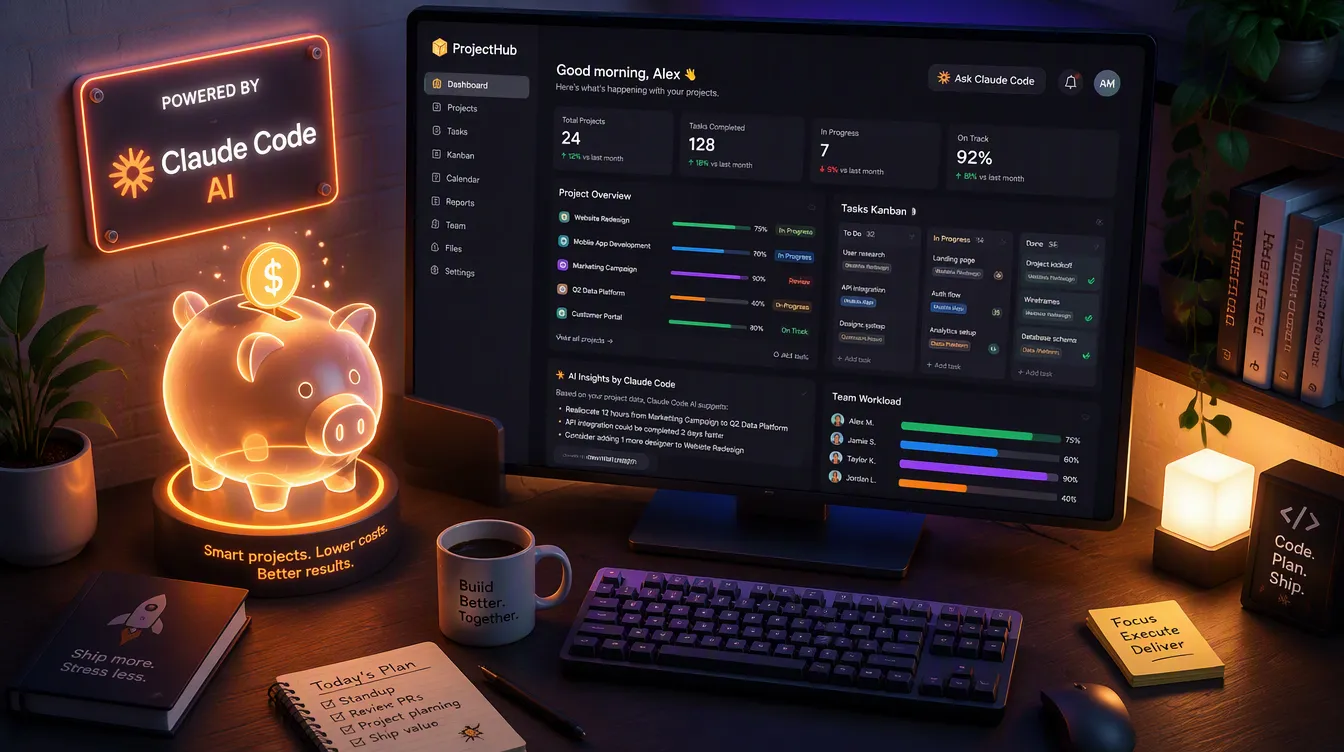
AI vibe coding for business
Why We Fired Our Software Subscriptions and Started Building With AI Instead
A few months ago I sat down and did something I should have done years earlier. I opened up the bank statement and actually added up every single software subscription running quietly in the background of the business.
I won’t tell you the number. It’s embarrassing.
Project management, ticked. Invoicing, ticked. A scheduling tool, ticked. Something for forms. Something else for automations. A thing we signed up for eighteen months ago that, and I’m not proud of this, I genuinely could not remember what it did.
Death by a thousand $19-a-months. That’s what subscription creep actually feels like once you add it up in one sitting instead of watching it drip out one card statement at a time.
So what happened? Slowly, one by one, I started cancelling them. Not because I suddenly stopped needing what they did for us. Because I started building the thing myself, with AI, exactly the way we actually needed it to work.
The shed in the shed-shaped hole
Here’s the bit that nobody really tells you about renting your business software.
You’re not just paying the monthly fee. You’re bending your entire business around whatever shape the developer decided your business should be.
Think about buying a garden shed off the shelf at the hardware store. It fits a shed-shaped hole. It’s fine. It’s got a door and a roof and it’ll keep the rain off your tools. But it doesn’t fit your actual yard, your actual slope, or the fact that your ride-on mower is twelve centimetres too wide for the door they installed.
So what do you do? You either buy a smaller mower, or you take the angle grinder to the doorframe every single time you want to get the mower out. Multiply that by every process in your business, and that’s what running on off-the-shelf SaaS tools actually feels like once you’ve been in business a while. You’re not running your business. You’re running the compromises around your business.
What I have learnt is that AI vibe coding flips this completely on its head.
Instead of buying the shed that’s closest to the shed you need, you describe the actual shed. The actual yard. The actual mower. And it builds that one, for you, specifically.
Our project management system, and why it finally works
We used to run our project management through one of the big-name subscription platforms. It was fine. It did the things it was built to do.
The problem was, it wasn’t built for us. It was built for approximately eleven million other businesses, all doing completely different things, all trying to force their process through the same set of boxes and drop-down menus.
We had fields we never used, cluttering up every screen. We had workflows we had to fake our way around because the “real” way the software wanted us to do it didn’t match how we actually run a job from enquiry to invoice. And we paid every month for the privilege of working around software that was, at best, seventy percent right for us.
Now? Our system tracks exactly what we track, in the order we actually do it, using the language we actually use internally. No workaround. No “well, it’s not perfect but it’s close enough, I suppose.” It fits, the way a good pair of stage boots fits after you’ve worn them in. Except we didn’t have to wear this one in. We just built it that way from the start.
Two wins, and don’t sleep on the second one
There’s an obvious win here, and I’d be lying if I said the money wasn’t nice. Cancelling a stack of subscriptions adds up to real savings over a year, and for a growing business every dollar not going out the door on rent-a-software is a dollar you can put somewhere that actually grows the business.
But here’s the thing. The bigger win isn’t the money.
The bigger win is that everything finally fits.
When your tools fit your business instead of your business bending around your tools, you move faster. Decisions get made quicker because nobody’s arguing about “how do we even record that in the system”. Onboarding a new team member gets simpler because the tool matches how you actually explain the job, not how some product manager in another country decided it should be explained. And when your business changes, and it will, you’re not stuck waiting for a feature request to get “considered for a future release”. You just change it.
But is it actually that simple?
I hear you asking. Isn’t building your own software a massive, expensive, risky exercise that used to require a developer, a project brief, three months and a small fortune?
It used to be exactly that.
That’s what AI vibe coding has actually changed. You describe what you need, in plain language, the way you’d explain it to a new staff member on their first day. The AI writes the actual application. You test it, you tell it what’s wrong or what’s missing, and it adjusts. It’s less like commissioning a piece of custom furniture from a tradesman with a six-week waitlist, and more like sitting down with a mate who happens to be an incredibly fast, incredibly patient builder, who never gets annoyed when you say “actually, can we move that button” for the fourth time.
Now, I’m not a rocket scientist, and I promise you don’t need to be one either. You don’t need to know how to code to get real value out of this. You need to know your business, know your process, and be willing to describe it clearly. The AI does the actual building.
Why this matters more as you grow
Here’s the part that matters most for a growing tech business specifically.
When you’re small, the gaps between what the software does and what you actually need don’t hurt that much. You’ve got two staff and a laptop each, and you can paper over the cracks with a shared spreadsheet and a good memory.
But as you grow, those small gaps become genuine friction. More people means more workarounds being taught to more new starters. More departments means more mismatched tools that don’t talk to each other properly. More customers means more mistakes slipping through the cracks that the “almost right” software didn’t quite catch.
A business built on tools that actually fit scales properly. A business built on tools that are “close enough” scales its problems right along with it.
The takeaway
I’m not saying cancel every subscription tomorrow and vibe-code your entire business overnight. Some things genuinely are better left to the specialists, and there’s no shame in that.
But have a proper look at what you’re renting, and ask yourself honestly, is this shed actually the shape of my yard? Or have I just been quietly angle-grinding the doorframe every day and calling it normal?
For us, replacing the rented, generic tools with AI-built ones that match exactly how we work has been one of the smartest moves we’ve made as we’ve grown. We save the money. We get the fit. Win-win.
Put down the credit card, stop shopping for someone else’s shed, and go build your own.
It is a lot of fun.