
What Building an Eco-Tourism Course Taught Me About Design
Instructional design across industries
I built an island once.
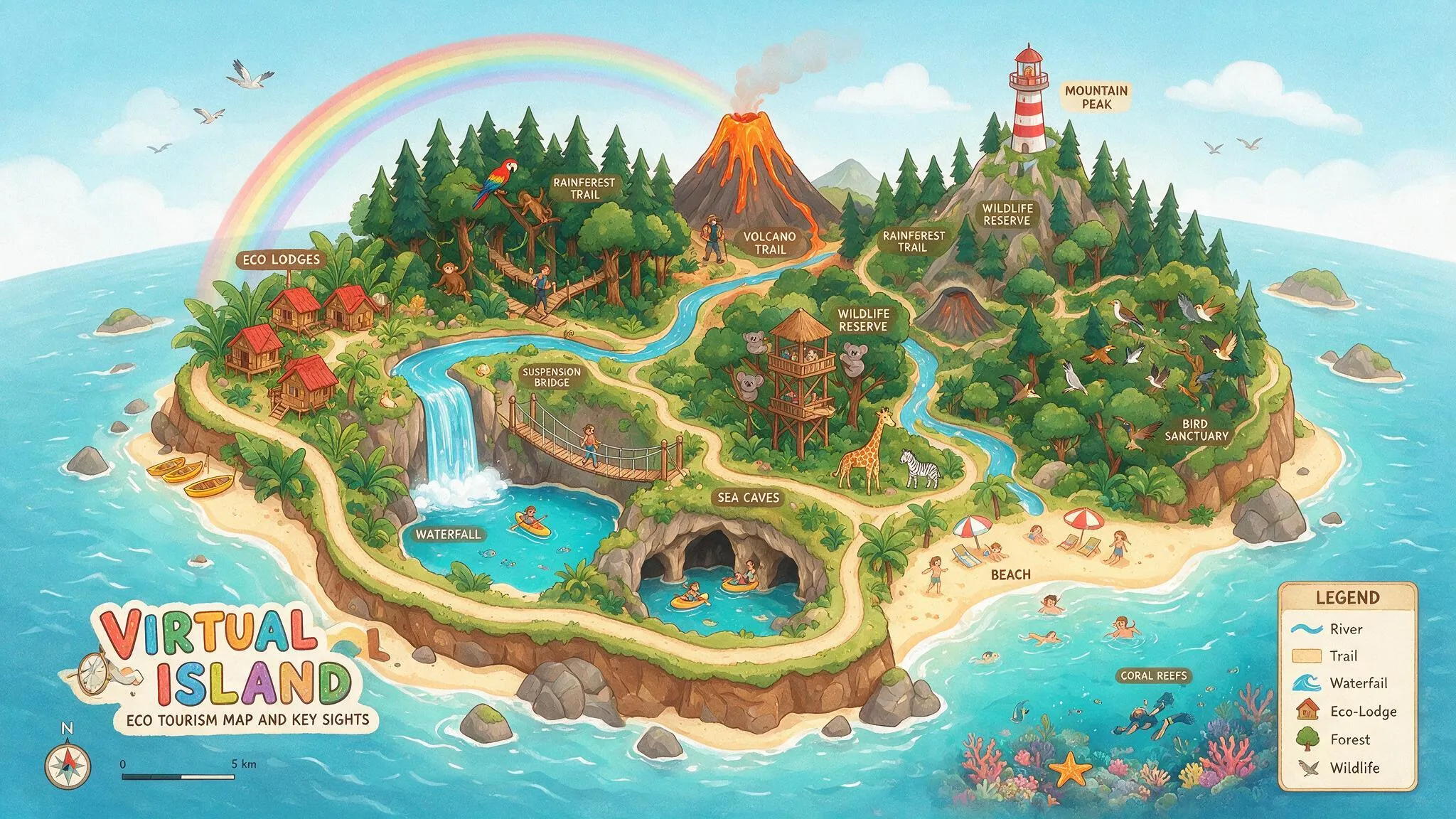
Not for fun. Not as some weekend hobby project with a 3D printer and too much free time. A client came to me with an eco-tourism training need, and somewhere in the planning meeting the idea landed on the table: what if we built the whole island?
So we did. A full 3D environment, built from scratch, overlaid on top of Google Earth so it actually sat in a real place in the real world. You could walk the trails. You could stand at the lodge. You could look out over water that didn’t exist anywhere except in our project files.
What started out as one training scenario very quickly stopped behaving like one.
From one scenario to five
The original brief was fairly narrow. Teach eco-tourism operators how to run a genuinely sustainable operation. But once the island existed, the questions started multiplying.
Could we use it for hospitality training? Obviously, yes. Front desk, guest interactions, the whole welcome experience, all playable inside the same environment.
Could we use it to teach bushwalking safety? Also yes. Same trails, same terrain, different learning objective sitting on top.
Sustainability practices? Waste management, water use, protecting the local ecosystem? Same island again, just pointed at a different outcome.
By the time we finished, one environment was quietly doing the work of four or five separate courses. Not because we planned it that way from day one, but because the technology turned out to be far more transferable than the subject matter ever was.
The bit that actually surprised me
I’ve been doing this long enough that building interactive scenarios wasn’t new to me. What was new was noticing, properly noticing, that the island didn’t care what it was teaching.
The 3D environment, the branching decisions, the way a learner moved through a space and made choices along the way, none of that changed based on whether the topic was hospitality or sustainability. What changed was the content sitting inside the structure.
I’d spent years quietly assuming that good instructional design in one industry meant I understood that industry. Turns out that’s back to front. I didn’t need to be a marine biologist to build a course about protecting reef ecosystems. I needed to know how people learn, how to sequence a scenario, and how to make a decision point feel like it actually mattered.
The eco-tourism client didn’t hire me because I knew eco-tourism. They hired me because I knew how to build a course that worked.
Why this matters if you only build for one industry
If you’re an instructional designer or an LMS admin working inside a single sector, healthcare, finance, retail, whatever it happens to be, it’s easy to start believing the sector is the skill. That you’re good at building courses for aged care, or good at building courses for compliance, and that’s your lane.
But is it?
I’ve built courses for eco-tourism, animal studies, the music business, live production and retail. On paper, those industries share almost nothing. A sound engineer and a wildlife park don’t exactly cross paths at industry conferences. But strip away the subject matter and the same bones show up every time. A learner needs a reason to care. They need a decision that has consequences. They need to walk away doing something differently, not just knowing something differently.
The island taught me that the technology and the learning principles travel. The content is just the passenger.
What I have learnt
Subject matter expertise and instructional design are not the same skill, and treating them as one thing is the fastest way to box yourself into a single industry.
The real skill is understanding how someone learns, then being curious enough to go and understand just enough about the subject to build the right scenario around it. You don’t need to become the eco-tourism expert. You need to be willing to sit down with the eco-tourism expert, ask a hundred slightly annoying questions, and then go build the island.
Once you can do that, the industry stops being the limitation. Your design thinking becomes the transferable asset, and that asset works whether you’re teaching someone to check in a hotel guest or teaching someone to mix a live show.
Build the island once. Then let it teach whatever it needs to.
Instructional design across industries