
Learning from failure
Why Your Failures Make a Better Story Than Your Wins
The Room That Was Too Small for Failure. learning from failure.
One of the best Moodle Moot sessions I’ve ever sat in wasn’t really a session I sat in at all — I was standing, wedged against a wall, with about a hundred other people who couldn’t get a seat.
The breakout room held 50 people. Comfortably. On paper.
By the time the session was due to start, there were over a hundred crammed inside and another hundred lined up in the corridor, hoping someone would leave so they could squeeze in. In the end, they had to shut the whole thing down and move it to a bigger room. Before it had even started.
Now, if you’d asked me to guess what topic could cause that kind of stampede, I’d have put money on something flashy. A big name. Some brand new AI tool that promised to save everyone six hours a week. That’s usually what pulls a crowd these days.
But it wasn’t that.
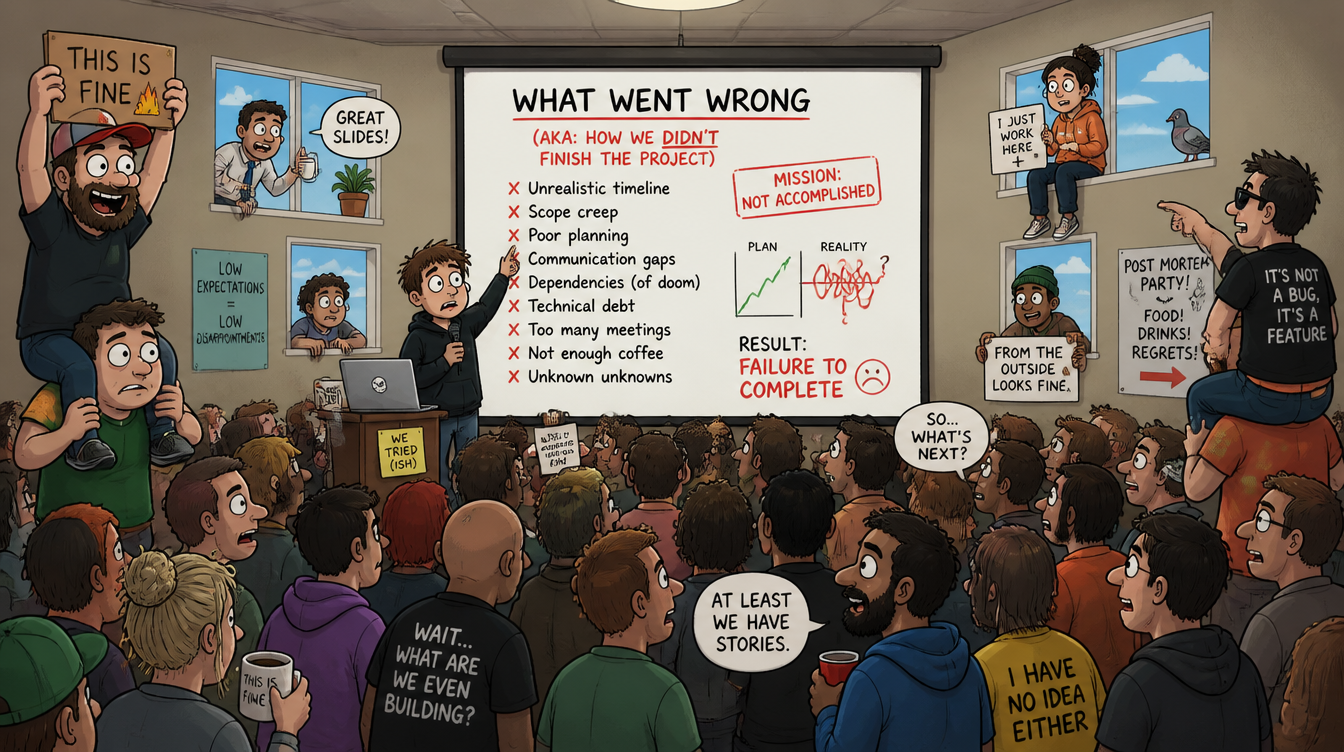
The session was called “How We Failed at Completing Our Project.”
That was it. No spin, no redemption arc promised in the title. They didn’t even hint that they’d eventually pulled it all together and everything worked out fine in the end. Honestly, I don’t think it did.
And yet, that was the session everyone wanted to be in.
Why Failure Fills the Room
I’ve thought about this a fair bit since, and I reckon there are two reasons.
The first one is pretty simple: nobody talks about their failures. It’s not exactly a flex to stand up in front of a room and say “here’s everything that went wrong.” It’s much more self-serving to talk about your wins — the album that charted, the tour that sold out, the six-figure launch. Success stories are easy to tell because they make you look good, and let’s be honest, most of us want to look good.
But the second reason is the one that actually matters. People weren’t there to be inspired. They were there to find out what not to do.
Think about it. If someone tells you exactly how they built a successful project, you get one path — theirs, in their circumstances, with their luck and timing baked in. But when someone tells you exactly where it fell apart, and more importantly, when it fell apart, you suddenly have a map of the traps. You know where the hole in the footpath is before you step in it.
What made that session so good wasn’t just the confession. It was that they’d actually gone back and done the work — dug into why it went wrong, found the specific trigger points where things started to slide. That’s a very different thing to just standing up and saying “yeah, it didn’t work out.” That’s forensic. That’s useful.
The Problem With Only Posting the Wins
So much of what we put out there — on social media, in our bios, in the story we tell about our own careers — is the highlight reel. The gig that went off. The song that clicked. The moment it all came together.
And there’s nothing wrong with that. Celebrate your wins. Please, celebrate your wins.
But if that’s all you ever show people, you’re doing them a disservice. Because the truth is, most of what actually teaches us — as musicians, as creators, as humans trying to build something — comes from the version of the story where it didn’t go to plan. The gig where nobody showed up. The recording that never got finished. The band that fell apart after four gigs and a fistfight over the setlist.
Those stories don’t get told very often. Which is exactly why, when they are told properly, people will queue out the door and down the corridor to hear them.
So Here’s What I’m Going to Do
I’ve been sitting here thinking about my own list of things that went sideways. And there’s a few. Actually, there’s more than a few.
Maybe my next post needs to be about one of them. Properly. Not the “here’s how I bounced back and it’s all good now” version — the actual, unglamorous, this-is-where-it-went-wrong-and-here’s-why version.
Because if a room full of Moodle Moot attendees will pack in shoulder to shoulder for someone else’s project failure, then there’s clearly an appetite for it. And if it’s true for a bunch of educators talking about an online learning project, I reckon it’s just as true for musicians, songwriters, and anyone else trying to build a career out of something they love.
It’s not about me looking good. It’s about you learning something you can actually use.
The best lessons rarely come wrapped in a win.
Learning from failure